


Head of Department: Masich Grigory Fedorovich
Phone: +7 (342) 237-83-76
E-mail:
The Institute's computing infrastructure has evolved through several stages: from two BESM-6 computers with a total performance of 1 MFlops (1980-1994) and an Elbrus 1-KB computer (3 MFlops, 1990-1994), to parallel computing systems like the MVS-1000/16P (12 GFlops, 2000-2014), and the Triton supercomputer (23 TFlops, operational since 2014).
In the late 20th century, the Perm segment of the "Ural" Academic Network (a regional research and education network operating on the X.25 protocol) was developed. The Institute installed the TISA-5 terminal system and an SM-1300 Packet Switching Center, connected via a 2400 bps leased line to the "Ural" Packet Switching Center at the Institute of Mathematics and Mechanics of the UB RAS (Sverdlovsk, 1985). This marked the first instance in Perm where traditional telecommunications operators were given access to the information and computing resources of the USSR and abroad. In the early 21st century, the laboratory began creating and developing the information and telecommunications infrastructure for the Perm Federal Research Center (PFRC) of the UB RAS. This was implemented using optical fiber and wavelength-division multiplexing (WDM) systems: a CWDM network connecting the institutes of the PFRC at speeds of 1-10-20 Gbps, and a DWDM link between Perm and Yekaterinburg at 40 Gbps, providing access to the supercomputing resources of the Institute of Mathematics and Mechanics of the UB RAS.
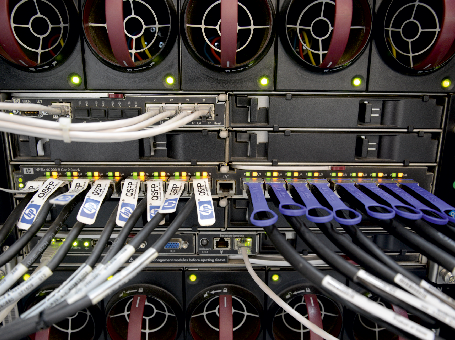
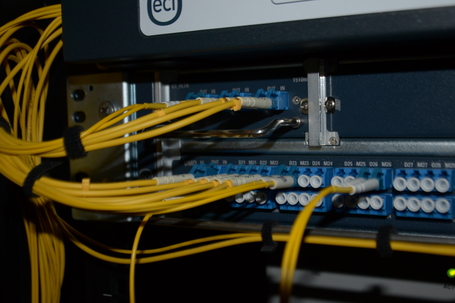
The self-sufficiency and reliability of the PFRC's IT infrastructure are ensured by a provider-independent block of IPv4 addresses obtained from the RIPE NCC, allowing for its own routing policies. Fault tolerance and high availability are achieved through a combination of redundancy methods and graceful degradation of equipment and communication lines. The PFRC's organizational and territorial structure enabled the deployment of two data centers on opposite banks of the Kama River, connections to two independent internet providers, and the installation of a hyperconverged virtualization platform that supports over 100 PFRC services (email, DNS, portals, websites, video conferencing, logging, monitoring, and management systems, etc.).

Building a regional cyberinfrastructure that integrates supercomputers, data storage systems, instruments, and experimental facilities via high-speed optical networks, creating a technological foundation for scientific projects addressing complex micro- and macro-scale problems

Developing methods and software tools for ingesting high-speed data streams from measurement systems and experimental setups into supercomputers, enabling real-time control of these setups based on computation results from high-performance systems.

Designing architectural solutions that ensure structural reliability and survivability of spatially distributed information and communication systems and networks under a single administrative domain, possessing their own Autonomous System (AS) number and a provider-independent block of IP addresses
Giga-Ural Initiative
|
|
|
|
|
|
| Arkhangelsk | Syktyvkar | Izhevsk | Perm | Ekaterinburg |
| Arkhangelsk research center |
Komi research center |
Udmurt research center |
DWDM System Control Center |
The URAN Supercomputer performance 326 Tflops |
|
|
|
|
|
| brings together | 40 Gbit/s | uses | effective |
|
5 research centers
|
throughput
|
dark fibers and DWDM
|
economically
|


