


Head of the Laboratory: Svistkov Alexander L’vovich
Phone: +7 (342) 237-83-15
E-mail:
The Laboratory of Micromechanics of Media with Inhomogeneous Structure was established in 1977 by Doctor of Technical Sciences, Professor Valery V. Moshev, who was the first head of the Lab. Since 1993 the Lab is headed by Professor Alexander L. Svistkov, Doctor of Physical and Mathematical Sciences. Under his leadership, research on the structure and properties of elastomer composites, initiated by Professor V.Moshev, continues.
The Laboratory team conducts theoretical and experimental studies on polymer nanocomposites reinforced with innovative filler systems. Simultaneously, efforts are underway to develop new prepregs and polymers with plasma-modified surfaces. The laboratory portfolio includes joint research with the Synthetic Rubber Research Institute (Saint Petersburg), the Research Institute of Tire Industry (Moscow), the Institute for Polymer Research (Drezden), and the Perm State University (Perm). The Lab also works with the State Medical University (Perm) and the Institute of Ecology and Genetics of Microorganisms UB RAS (Perm) in the field of mechanics of biocompatible materials.
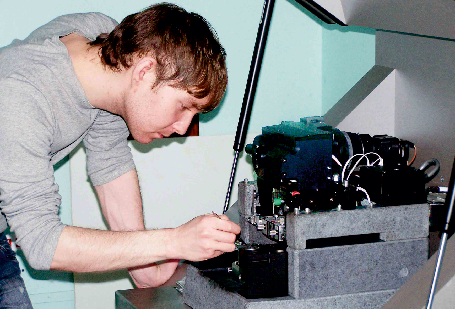
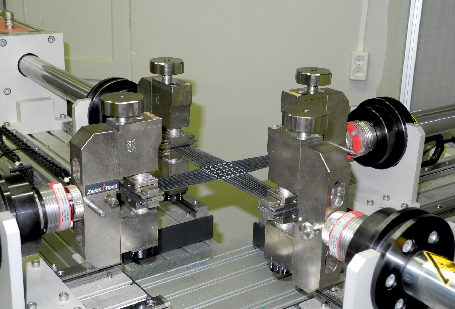
The team’s advanced knowledge of polymeric materials and strong skills in mechanical testing enable researchers to effectively analyze experiment results and propose new investigative approaches using state-of-the-art equipment. The Laboratory team has developed and patented original experimental techniques, such as a method for studying uniaxial cyclic deformation with nested cycles and cycles with increasing amplitude, a method for testing rubber under shear conditions; and a method for fabricating and testing specimens for simultaneous deformation in two directions with independent loading programs for each axis.
The Lab also develops models to explain the viscoelastic behavior of filled polymers under finite deformation. One of the key objectives of the laboratory is to determine a relationship between the mechanical properties of a material observed at the macro level and its characteristics, considering material structure at micro- and nanoscales. For this purpose, experimental approaches, models and methods for analyzing atomic force microscopy results are developed. In particular, methods to visualize filler particles beneath the sample surface are created, and approaches based on artificial intelligence are applied to analyze composite microstructure. An important part of the Lab fundamental research is the derivation of constitutive equations in a general formulation for the models of nonlinear dissipative media operating under finite deformations and testing these equations for objectivity within the framework of continuous medium thermodynamics.

Material structure analysis based on optical and scanning probe microscopy, nanoindentation
Morozov I.A. et al. eXpress Polym. Lett. 2018. V. 12. No. 4. P. 383–394

Development of mathematical models for the interaction of scanning probe with elastomeric material and their use in the analysis of experimental data obtained using atomic force microscopy
Morozov I.A. Polym. Test. 2021. V. 94. Article No. 107038

Investigation of viscoelastic properties of polymer nanocomposites under complex strain history at finite deformations. Study of the softening effect. Analysis of induced anisotropy after material softening.
Svistkov A.L. et al. Mech. Mater. 2020. V. 148. Article No. 103500

Multiscale modeling of media with inhomogeneous structure, theoretical analysis of the mechanisms of formation of the macroscopic behavior of nanocomposite considering material structure
Kondyurin A.V. et al. Materials. 2018. V. 11. No. 10. Article No. 1992

Derivation of thermodynamic constitutive equations for viscoelastic media at finite deformations
Beliaev A.Y. et al. Eur. J. Mech. / A Solids. 2023. V. 102. Article No. 105103