



The Laboratory is part of the Department of Physical Hydrodynamics
Head of the Laboratory: Ivanov Aleksey Sergeevich
Phone: +7 (342) 237-83-25
E-mail:
The laboratory was established in 1991 on the initiative of Doctor of Physical and Mathematical Sciences, Professor Mark Isaakovich Shliomis. The main research goal of the Laboratory is to perform an experimental and theoretical study of magnetic colloidal systems (magnetic fluids) and soft materials containing magnetic particles (magnetic elastomers, ferrogels). Laboratory topics were formed by relying on two scientific schools: the experimental school of Professor Alexander Fedorovich Pshenichnikov, Doctor of Physical and Mathematical Sciences, and the theoretical school of Professor Yuri L’vovich Raikher, Doctor of Physical and Mathematical Sciences.
Magnetic fluids are colloidal solutions of single-domain ferromagnetic nanoparticles in a non-magnetic carrier fluid, which demonstrate a unique combination of contradictory properties: magnetism and fluidity. As a result, magnetic fluids have a wide range of applications, such as seals and magnetic fluid separators for gold, platinum, and diamond mining. They are used in the manufacture of high-quality loudspeakers, as well as in the medical procedures for cancer treatment. Magnetic fluids have found extensive applications in instrumentation like tilt sensors and accelerometers.
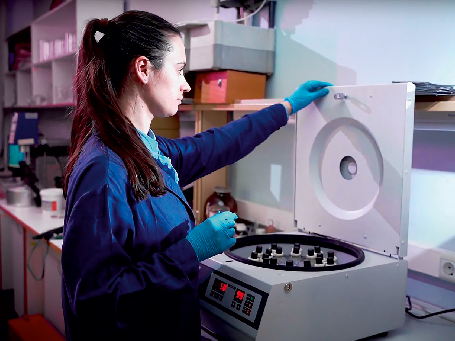
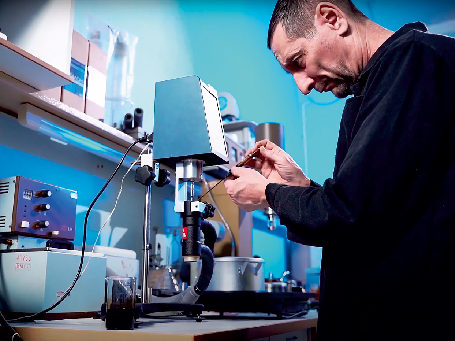
Magnetic elastomers are polymer-based composites with embedded ferromagnetic microparticles. At the macroscopic level, these materials appear homogeneous. The application of a magnetic field to a composite with magnetic particles in a soft matrix can change its mechanical properties, including shape and deformation. Magnetic elastomers have found wide application in engineering. They are used as adaptive dampers, "soft" manipulators, vibration sensors, and even as magnetically controlled microrobots.
From a fundamental perspective, dispersed magnetic materials in soft (liquid, polymer, or gel) matrices are of great interest because they can be treated as unique model media with extremely strong interparticle interactions, driven by gigantic magnetic moments exceeding the dipole moments of individual atoms or molecules by several orders of magnitude. This offers broad possibilities for experimental studying non-central dipole-dipole interparticle interactions of the structural elements of a microworld within a vast variety of control parameters (temperature, field strength, dispersed phase concentration).

Synthesis of magnetic fluids with required magnetic, rheological, and thermophysical properties
Lebedev A.V. et al. Colloid J. 2020. V. 82. P. 288–294

Description of hydromechanics and controlled transport of bodies immersed in magnetic fluid
Ivanov A. S. et al. Phys. Fluids. 2021. V. 33. Article No. 112001

Development of physical models of novel magnetically sensitive devices (gauges, dampers, sensors)
Ivanov A. S., Koskov M.A. Patent for an invention No. 2788591. 2022.

Study of interphase hydrodynamics of magnetic and non-magnetic liquid media
Khokhryakova C. et al. Langmuir. 2024. V. 40. P. 4285–4293

Development of a mesoscopic theory of magnetic elastomers - polymeric matrices filled with magnetic micro - and nanoparticles
Biller A.M. et al. Phys. Rev. E. 2024. V. 110. No. 6. Article No. 064501

Fundamental theoretical studies of magnetodynamics of single-domain ferromagnetic and ferrite particles
Poperechny I.S. Phys. Rev. E. 2024. V. 109 Article No. 044601