


Scientific adviser of the Lab: Plekhov Oleg Anatolievich
Phone: +7 (342) 237-83-21
E-mail:
The Laboratory of Solid Thermomechanics, supervised by Oleg Anatolievich Plekhov, Doctor of Physics and Mathematics, Corresponding Member of the Russian Academy of Sciences, was created in 2018. The Lab was separated as an independent unit from the Laboratory of Physical Foundations of Strength, headed by Doctor of Physics and Mathematics, Professor Oleg Borisovich Naimark, who established research traditions that form the basis for a new scientific direction at the ICMM UB RAS.
The interests of the Laboratory lie in theoretical and experimental research in thermodynamics of plastic deformation, damage and failure of structural and natural materials. The Lab also conducts studies to develop non-destructive testing methods for mechanics of deformable solids. Based on a structural-energy approach, effective methods were developed to increase the fatigue strength of structural materials, including those undergoing gigacycle fatigue.
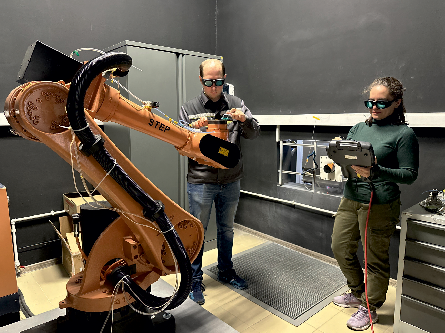
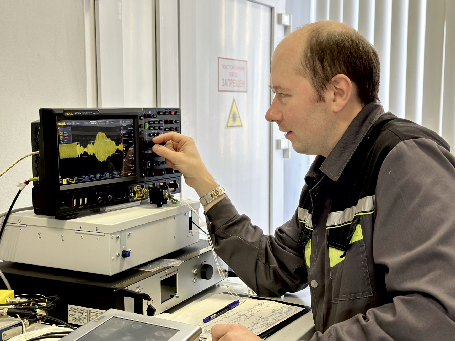
Current laboratory research combines experimental study and mathematical modeling to develop models for residual stress formation, damage initiation and evolution in structural materials, accompanying laser shock surface hardening. A setup for providing a wide range energy of laser shock peening on materials was designed.
In the geomechanical field, the Lab research focuses on developing anisotropic damage models in order to explain and describe orientation effects of rock fracturing: the Kaiser effect and the selective response of fluid-saturated formations to seismic waves.
The geotechnical field, the Lab scientific efforts are directed toward performing investigations of deformation localization and damage evolution in rocks and rock masses as applied to geomechanical safety issues during mining operations. The laboratory develops theoretical models and methods for their verification on scales ranging from microscopic (CT scanning) to geophysical (borehole surveys and InSAR technique). The Lab team’s applied research involves interpreting complex borehole measurements in order to assess changes in regional stress fields and update pillar stability criteria for potash deposit.
The team members are properly trained and qualified in leading Russian and International research centers. These skills have established significant potential for developing the laboratory research area, solving fundamental scientific problems, and collaborating with industrial partners.

Theoretical and experimental study of damage accumulation and evolution in metallic and composite materials during their deformation and failure
Vedernikova A.I., Plekhov O.A. et al. Theor. Appl. Fract. Mech. 2019. V. 103. Article No. 102280
Panteleev I.A. et al. Eur. J. Mech. A-solid. 2021. V. 85. P. 1–14

Experimental studies on the processes accompanying the structure evolution of material during its deformation and failure on the basis of a set of non-destructive control methods (acoustic emission, thermal imaging, digital image correlation)
Iziumova A.Yu. et al. Eng. Fract. Mech. 2024. V. 295. Article No. 109735

Development of models of deformation of rocks and rock masses under arbitrary three-dimensional loads
Panteleev I.А. et al., European Journal of Mechanics – A/Solids. – 2021. – Vol.85. – P. 104085.
Panteleev I.А. et al., Journal of Mining Institute. – 2022. – Vol. 254. – P. 234-243.
Panteleev I.А. et al., Geophysical Journal International. – 2024. – Vol. 237 (2). – P. 996-1009

Development of laser impact forging technology for metals and optimization of processing modes to increase the fatigue life of metal parts with complex geometries. Study of the strength, fatigue, and corrosion characteristics of metallic materials after laser impact hardening
Gachegova E. et al. Metals. 2024. V. 14. № 9.

Mathematical modeling and optimization of technological processes. Modeling of mining operations and natural processes in rock masses. Modeling of energy balance during inelastic deformation of metals
Bartolomei M. et al. Frat. Integrita. Strut. 2024. No. 67. P. 1–11
Vshivkov A. et al. Theoretical and Applied Fracture Mechanics. 2019. V. 103. P. 102308.